The Edge of the Frame Is Part of the Story
The edge of the frame shapes what viewers notice and infer. Learn how framing, cropping and off-screen space make a composition’s focus more legible.
In a small gallery, a visitor stops at a photograph of a half-open door. The door fills one side of the image; a strip of corridor remains visible beyond it. The frame cuts off whatever lies farther down the hall. That boundary shapes what the visitor can see, what they infer and what they want to look for next. The edge of the frame is part of the story.
Consider an invented commission: a filmmaker is making a short scene about a caretaker who hears a sound after closing a neighbourhood library. The source should remain uncertain without making the image feel arbitrary. Framing can turn the limits of the image into an active part of the viewer’s attention.
Setting the composition
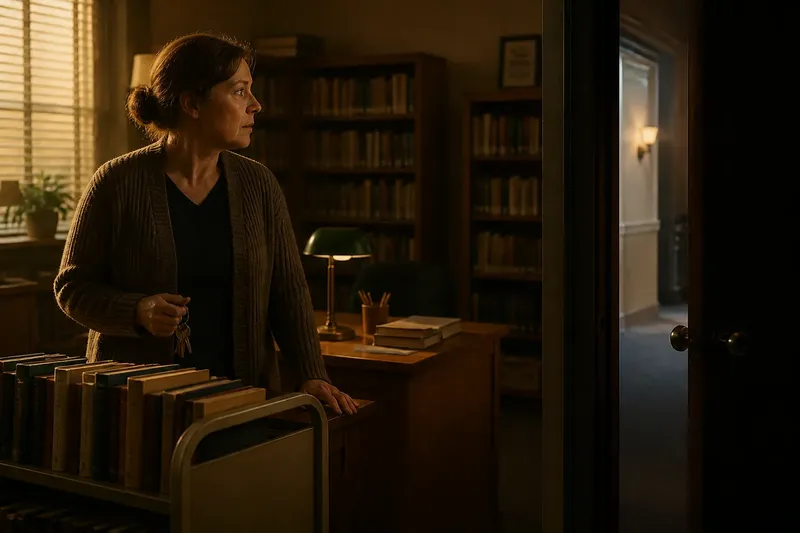
Imagine the filmmaker begins with a wide shot of the reading room. The caretaker stands near a desk, a book trolley occupies the foreground, and the doorway sits at the back of the room. There is plenty to inspect, but the sound has not happened yet. The room feels available to the eye rather than charged with a particular possibility.
For the next shot, the filmmaker moves closer to the caretaker and places the doorway near the right edge. Most of the room disappears. The caretaker’s face and the unlit doorway now share the viewer’s attention, while the cropped book trolley no longer distracts from them. This is not simply a tighter view. It is a choice about which relationships remain visible.
A frame guides attention through placement, contrast, movement and available space. A face near the centre tends to draw notice, while an opening at the edge can suggest a route or an unseen presence. Neither effect is automatic: a bright lamp, a moving curtain or a sharp sound elsewhere may pull attention away. Framing creates conditions for looking; it does not dictate a single reading.
What stays outside
When the caretaker hears a soft knock, the filmmaker keeps the camera inside the reading room. The sound seems to come from the corridor, but the image does not confirm that impression. The doorway appears as a dark shape at the margin. Viewers can look towards it, yet they cannot see what lies beyond.
Off-screen space feels specific when the visible scene gives it boundaries. The doorway suggests a place just beyond the image; the caretaker’s turned head gives viewers a reason to consider it. Without those clues, an unseen source may feel like a vague trick. With them, the missing view becomes an active possibility.
There is a useful distinction between withholding and hiding. If the viewer has no visual or auditory reason to expect something beyond the frame, the omission may go unnoticed. If a character looks towards the edge, or a sound arrives from that direction, the absent area becomes part of the scene. The audience is not merely missing information; it is attending to a space the image has made meaningful.
Changing the boundary
Say the filmmaker now wants the caretaker’s choice to matter more than the possible source of the knock. They could widen the shot to include the desk, the exit and the caretaker’s hand resting beside a ring of keys. The frame would show a decision point: leave the room, investigate the corridor or remain where they are. A wider view would shift attention from the doorway alone to the caretaker’s options, not necessarily provide a clearer answer.
Alternatively, a close shot might show the hand tightening around the keys while leaving the face and corridor out of view. That crop would make the gesture legible but remove context needed to interpret it confidently. The viewer might read the grip as hesitation, readiness or simple habit. The filmmaker must decide whether that uncertainty serves the scene or muddies it.
To choose a crop, identify the scene’s main relation—in this case, caretaker and doorway—then check whether the edges preserve it. The frame can exclude incidental furniture, but it should not accidentally remove a cue the audience needs to understand why the caretaker looks up.
Questions about framing?
What does a tight crop do?
A tight crop reduces the number of visible details and can make a face, hand or object more prominent. It also removes context, leaving the viewer with less evidence for interpreting that detail.
Can an empty edge feel occupied?
Yes, if a look, sound or movement points towards it. The edge then marks a possible continuation of the scene rather than a neutral blank.
When should the camera show what is outside?
Show it when the audience needs the information to understand the action or judge a character’s choice. Keep it unseen when anticipation or uncertainty is intended, while offering enough cues for the omission to feel deliberate.
Does a wider frame explain more?
It can reveal more of the room, but added detail may compete with the subject. Ask whether the extra area clarifies a relationship, rather than simply supplying more visible material.
Reading the finished scene
In the invented scene, the filmmaker holds a medium shot as the caretaker listens. The doorway remains at the right edge; the caretaker’s eyes turn towards it. A second, quieter sound comes from the corridor, but no figure appears. The caretaker picks up the keys and moves out of frame. The camera stays in the library for a beat, leaving the doorway visible and the room empty.
Attention shifts as the scene unfolds. Viewers first inspect the caretaker’s reaction, then watch the doorway, and finally notice that the caretaker has left the image. The frame makes absence legible through what remains: the open passage, the unoccupied room and the direction of the sound. The scene does not need to show a hidden figure to make the corridor matter.
It is not worth painstakingly accounting for every object that might be excluded. Instead, check the edges for accidental distractions, cropped details that imply something unintended, and important cues that have slipped out of view. Then ask what the viewer is likely to expect just beyond each boundary.
The edge of the frame works best when it reflects a choice about attention. In the library scene, keeping the corridor partly unseen lets the audience share the caretaker’s uncertainty without losing track of its source. A boundary can conceal, direct or connect; its meaning depends on what the image offers right up to the limit.